Courtesy of: Becky from Page Turners
The Broken Shore is the precursor to Truth, the first crime novel to win the Miles Franklin Award, and so I was excited to be finally reading it. This is, however, the second Peter Temple book that I have read (An Iron Rose being the first), and whilst I very much enjoyed The Broken Shore, it was very reminiscent of An Iron Rose in terms of the characters, the setting and the plot.
The main character of this book is Joe Cashin, an ex-homicide detective who becomes involved in the investigation of the death of Charles Burgoyne, a local man of large wealth. His death is blamed on some young Aboriginals from the town, but Joe soon discovers that there is something more sinister behind the killing of Charles Burgoyne and the killings that follow.
The same comments that I made about An Iron Rose equally apply to this book. Temple's writing is very spare and gritty. He writes in the hardboiled style made famous by Hammett and Chandler. In fact, the main character in The Broken Shore, Joe Cashin, was very Marlow-esque. He was a complicated character. He had the hardness of an ex-homicide police officer, but was clearly enjoying being in a role where he could exercise his discretion and common sense without all the action.
Temple is skilled at capturing detail despite his spare writing style, and is able to effectively use dialogue to give the story and setting a distinctly Australian setting.
The good thing about The Broken Shore is that not only was he able to capture detail so well but he also covered many important political issues such as crime and justice, police corruption, Aboriginal politics, environmental protection and institutionalised sexual abuse.
I enjoyed The Broken Shore, although it moved very slowly and was worryingly similar to An Iron Rose, from my perspective anyway. I am now looking forward to reading Truth and seeing how it is distinct from these novels.
Showing posts with label Contemporary. Show all posts
Saturday, February 12, 2011
Tuesday, January 18, 2011
Gunshot Road by Adrian Hyland
Courtesy of: Bernadette from Reactions to Reading
Emily Tempest has become the world's most unlikely cop, an Aboriginal Community Police Officer no less. On her first day on the job in Bluebush in the Northern Territory she is one of the officers called to the scene of a stabbing out at Green Swamp Well. On the surface it looks like an open and shut case: two old drunks got into a fight and one stabbed the other in the neck. But to Emily, who knows both the victim (Doc) and the suspect (Wireless), something doesn't feel right and she can't let the investigation slide.
Gunshot Road has it all. Literally. Everything I could possibly want from a work of fiction all in one gorgeous package.
First there are fantastic characters. Emily Tempest is brave and stubborn and smart and funny and, as was the case with the first book in which she features, I'm still not entirely sure how a bloke can create such a credible female character but I'm delighted he has. In this book she is more mature than in her first outing though she still struggles when she knows what she should do is not what she wants to do and usually her heart wins out over her head. For better or worse.
There are plenty of other beautifully depicted characters to look out for too. Like the teenage Aboriginal boy called Danny who is deeply troubled by something and unable to communicate his fears to Emily. And the town's new top cop, taciturn and uncomprehending of all the things he doesn't know, but trying to do the right thing in his way. And of course the setting, the harsh land in the country's centre, is just as much a character as any person in the book.
The desert isolation, the unrelenting heat, the laconic humour, the often awkward relationships between blacks and whites all combine to form an unmistakably Australian story. It's not always a pretty one though and no one could accuse Hyland of trying to make it so because he tackles touch subjects such as the rampant domestic abuse of women in Aboriginal communities, endemic poverty and racism. However he somehow manages to do it without once lecturing from a self-proclaimed moral high ground. That's a much rarer trait than it ought to be in modern literature.
Next there is writing that made me simultaneously jealous at someone else’s ability to string words together in a way that I will never be able to and grateful that he didn’t keep his gift to himself. This is from the opening chapter about an initiation
I could go on but I’d end up quoting the whole book. In short, Hyland's writing is a thing of beauty and the entire book is, in part, one long ode to its country.
Finally there is a great story and Gunshot Road is a more solid piece of crime fiction than its predecessor. For the first half of the novel there's a fairly slow, humorous approach to the investigation as we're introduced to all the players and people tease Emily about her new obsession. Then at a certain point the novel switches gears and speeds up as it becomes more serious and foreboding. Together these halves make up a perfectly paced story with a genuine nail-biting finish.
Heck the book even incorporates, glorifies actually, geology, my favourite science. What more could I possibly ask for? Gunshot Road is a funny, beautiful, sad and thoughtful book that everyone should read. Immediately.
Emily Tempest has become the world's most unlikely cop, an Aboriginal Community Police Officer no less. On her first day on the job in Bluebush in the Northern Territory she is one of the officers called to the scene of a stabbing out at Green Swamp Well. On the surface it looks like an open and shut case: two old drunks got into a fight and one stabbed the other in the neck. But to Emily, who knows both the victim (Doc) and the suspect (Wireless), something doesn't feel right and she can't let the investigation slide.
Gunshot Road has it all. Literally. Everything I could possibly want from a work of fiction all in one gorgeous package.
First there are fantastic characters. Emily Tempest is brave and stubborn and smart and funny and, as was the case with the first book in which she features, I'm still not entirely sure how a bloke can create such a credible female character but I'm delighted he has. In this book she is more mature than in her first outing though she still struggles when she knows what she should do is not what she wants to do and usually her heart wins out over her head. For better or worse.
There are plenty of other beautifully depicted characters to look out for too. Like the teenage Aboriginal boy called Danny who is deeply troubled by something and unable to communicate his fears to Emily. And the town's new top cop, taciturn and uncomprehending of all the things he doesn't know, but trying to do the right thing in his way. And of course the setting, the harsh land in the country's centre, is just as much a character as any person in the book.
The desert isolation, the unrelenting heat, the laconic humour, the often awkward relationships between blacks and whites all combine to form an unmistakably Australian story. It's not always a pretty one though and no one could accuse Hyland of trying to make it so because he tackles touch subjects such as the rampant domestic abuse of women in Aboriginal communities, endemic poverty and racism. However he somehow manages to do it without once lecturing from a self-proclaimed moral high ground. That's a much rarer trait than it ought to be in modern literature.
Next there is writing that made me simultaneously jealous at someone else’s ability to string words together in a way that I will never be able to and grateful that he didn’t keep his gift to himself. This is from the opening chapter about an initiation
I could go on but I’d end up quoting the whole book. In short, Hyland's writing is a thing of beauty and the entire book is, in part, one long ode to its country.
Finally there is a great story and Gunshot Road is a more solid piece of crime fiction than its predecessor. For the first half of the novel there's a fairly slow, humorous approach to the investigation as we're introduced to all the players and people tease Emily about her new obsession. Then at a certain point the novel switches gears and speeds up as it becomes more serious and foreboding. Together these halves make up a perfectly paced story with a genuine nail-biting finish.
Heck the book even incorporates, glorifies actually, geology, my favourite science. What more could I possibly ask for? Gunshot Road is a funny, beautiful, sad and thoughtful book that everyone should read. Immediately.
The town mob: fractured and deracinated they might have been, torn apart by
idleness and violence, by Hollywood and booze. But moments like these, when people come together, when they try to recover the core, they gave you hope.
It was the songs that did it: the women didn’t so much sing them as pick them up like radio receivers. You could imagine those great song cycles rolling across country, taking their shape from what they encountered: scraps of language, minerals and dreams, a hawk’s flight, a feather’s fall, the flash of a meteorite.
The resonance of that music is everywhere, even here, on the outskirts of the whitefeller town, out among the rubbish dumps and truck yards. It sings along the wires, it rings off bitumen and steel.
Monday, January 10, 2011
Jasper Jones by Craig Silvey
Courtesy of: Becky from Page Turners
Reading Jasper Jones by Craig Silvey has introduced me to a great new Australian writer that I am looking forward to reading more of.
Jasper Jones is set in the fictional rural Western Australia town of Corrigan, amidst a political backdrop of the Vietnam War and significant legislative change in Australia. One night, 13 year old Charlie Bucktin is awoken by a knock on the window from the town's local "thief, liar, thug and truant" - Jasper Jones. Jasper Jones is in fact a local indigenous boy, raised in appalling circumstances and treated as the local scapegoat whenever anything go wrong. Jasper entrusts Charlie with a secret so dark that it eventually leads to a mystery that envelopes the entire town of Corrigan.
I greatly enjoyed Jasper Jones by Craig Silvey. It was a page turner in the true sense of the phrase - I couldn't put it down. My biggest problem with it though, was that I couldn't figure out what genre it was supposed to be. The entire time I was reading the book I was asking myself "is this adult or young adult fiction?" I found myself so bothered by the fact that I couldn't figure it out that it became quite distracting. I know that it shouldn't make a difference what the genre is, so long as the reader enjoys the book (which I did). And yet, I couldn't shake off this overall feeling of confusion whilst I was reading the book that slightly hampered by enjoyment of it.
I think ultimately, this would have to be characterised as a book for young adults.
I appreciated that the book dealt with very real and important issues such as racial discrimination, prejudice, war and sexual assault. The opening scene were shockingly graphic (for a young adult book) and the final explanation of Jasper's shocking discovery is extremely confronting to say the least.
Silvey has written the book as a first person narrative from 13 year old Charlie Bucktin's perspective and for the most part his dialogue and inner monologue were authentic. I enjoyed the childish male banter between Charlie and his Vietnamese best friend Jeffrey Lu. It was short and sharp and funny and probably very much like what I imagine 13 year old boys would talk about.
At times though, I thought that the authenticity was lost a little. Silvey sometimes forces the childishness upon you, particularly the way in which Charlie and Jeffrey call each other names. Authenticity was also sometimes compromised when Charlie began to analyse the world and people around him; 13 year olds do not have the vocabulary and critical analysis skills that Charlie sometimes displays.
As far as a book for young readers goes, it dealt very effectively with the themes that it raises. Silvey deals with the daily reality of racism in the way that he writes about Jasper's beatings at the hands of the police, the destruction of the Lu family's garden in response to the Vietnamese War and the way in which Jeffrey courageously deals with the racial taunts he suffers at the hands of his teammates.
Issues of physical and sexual abuse and alcoholism are also honestly but sensitively raised.
I would almost be tempted to say that it is almost like an Australian young adult version of To Kill A Mockingbird. Those big issues such as a racism and prejudice are examined through the eyes of a child experiencing a microcosm of these issues in their own daily lives.
It was heartwarming to watch Charlie come to terms with his own personal reality - in this way Jasper Jones is certainly a coming of age story. As the book progresses we see Charlie struggle to understand his parents and their relationship and come to terms with the existence of prejudice and racism but also make friends and get some "sassytime" as Jeffrey so comically phrases it.
Despite the inconsistencies in the authenticity of Charlie's narrative voice, I greatly admired this book for its honest and funny portrayal of serious issues.
Although I found my personal confusion regarding the book's genre somewhat distracting, I would recommend this book as a great Australian read, especially for young adults.
Reading Jasper Jones by Craig Silvey has introduced me to a great new Australian writer that I am looking forward to reading more of.
Jasper Jones is set in the fictional rural Western Australia town of Corrigan, amidst a political backdrop of the Vietnam War and significant legislative change in Australia. One night, 13 year old Charlie Bucktin is awoken by a knock on the window from the town's local "thief, liar, thug and truant" - Jasper Jones. Jasper Jones is in fact a local indigenous boy, raised in appalling circumstances and treated as the local scapegoat whenever anything go wrong. Jasper entrusts Charlie with a secret so dark that it eventually leads to a mystery that envelopes the entire town of Corrigan.
I greatly enjoyed Jasper Jones by Craig Silvey. It was a page turner in the true sense of the phrase - I couldn't put it down. My biggest problem with it though, was that I couldn't figure out what genre it was supposed to be. The entire time I was reading the book I was asking myself "is this adult or young adult fiction?" I found myself so bothered by the fact that I couldn't figure it out that it became quite distracting. I know that it shouldn't make a difference what the genre is, so long as the reader enjoys the book (which I did). And yet, I couldn't shake off this overall feeling of confusion whilst I was reading the book that slightly hampered by enjoyment of it.
I think ultimately, this would have to be characterised as a book for young adults.
I appreciated that the book dealt with very real and important issues such as racial discrimination, prejudice, war and sexual assault. The opening scene were shockingly graphic (for a young adult book) and the final explanation of Jasper's shocking discovery is extremely confronting to say the least.
Silvey has written the book as a first person narrative from 13 year old Charlie Bucktin's perspective and for the most part his dialogue and inner monologue were authentic. I enjoyed the childish male banter between Charlie and his Vietnamese best friend Jeffrey Lu. It was short and sharp and funny and probably very much like what I imagine 13 year old boys would talk about.
At times though, I thought that the authenticity was lost a little. Silvey sometimes forces the childishness upon you, particularly the way in which Charlie and Jeffrey call each other names. Authenticity was also sometimes compromised when Charlie began to analyse the world and people around him; 13 year olds do not have the vocabulary and critical analysis skills that Charlie sometimes displays.
As far as a book for young readers goes, it dealt very effectively with the themes that it raises. Silvey deals with the daily reality of racism in the way that he writes about Jasper's beatings at the hands of the police, the destruction of the Lu family's garden in response to the Vietnamese War and the way in which Jeffrey courageously deals with the racial taunts he suffers at the hands of his teammates.
Issues of physical and sexual abuse and alcoholism are also honestly but sensitively raised.
I would almost be tempted to say that it is almost like an Australian young adult version of To Kill A Mockingbird. Those big issues such as a racism and prejudice are examined through the eyes of a child experiencing a microcosm of these issues in their own daily lives.
It was heartwarming to watch Charlie come to terms with his own personal reality - in this way Jasper Jones is certainly a coming of age story. As the book progresses we see Charlie struggle to understand his parents and their relationship and come to terms with the existence of prejudice and racism but also make friends and get some "sassytime" as Jeffrey so comically phrases it.
Despite the inconsistencies in the authenticity of Charlie's narrative voice, I greatly admired this book for its honest and funny portrayal of serious issues.
Although I found my personal confusion regarding the book's genre somewhat distracting, I would recommend this book as a great Australian read, especially for young adults.
POSTSCRIPT: After writing the following sentence in my review "I would almost be tempted to say that it is almost like an Australian young adult version of To Kill A Mockingbird" I realised that something very similar was printed on the front cover of the book. I would just like to say that I am not copying the reviewer who is responsible for the comment on the front cover. I did actually think that to myself before reading it on the book.
Friday, January 7, 2011
How it Feels by Brendan Cowell
Courtesy of: Danielle from The Book Nerd ClubFrom the back cover:
'I had no idea how free we were. That's how free I was'.
An old friend, a best friend, a first love and the dreamer Neil who connects them all...Over the next twelve hours, their lives will change forever - friendships will be broken, virginity lost, love unleashed and secrets buried. A decade later, one is dead, one is famous, two are getting married, and the truth is about to erupt. Wildly funny, brutal, tender and true, Brendan Cowell's electrifying debut novel is a devastating ode to youth, capturing the beauty of growing up by the beach, and the darkness which moves beneath its surface. Because this is how it feels.'
Review:
'How it Feels' is the perfect title for this book. There seems to be this new wave of Australian male writers (or at least it seems to be a new wave, but maybe they've always been there and I'm only just discovering them) who are willing to write about the experience of being male from a feeling point of view. There's been plenty of work done by other Australian men which describe confronting and shocking events that put a spotlight on the world we live in. Tim Winton is an example of this, an amazing writer who is willing to write about the things that people might not want to look at and see. But what these previous writers have done is describe the events, and in doing so tell a story. What Brendan Cowell has done is gone deeper. He has managed to take the events in the books and describe the feeling of them. In doing so he is writing much more than just a story, he is writing the truth.
This is a searing look at the experience of growing up as a young Australian man, the brutality of this life that takes innocent, beautiful young boys and turns them into damaged and damaging men. There is a lot in this book that is confronting. The events and the choices the characters make, but for this reader, what is really confronting is the feelings. There is this beautiful exploration of the notion that by wanting to run away from people and a place, what you are really wanting to run away from is yourself with these people in this place, and that this is actually impossible. That wherever you go, there you are. These feelings, these experiences are always with you, you can't escape them, and how unbearable that can be. The books asks 'Do you want to know what it feels like to be this kind of man, can you really bear it?' Suicide is a major theme in the book, and really, it's not hard to see why in some communities in Australia male suicide is so prevalent. Brendan Cowell uses the word 'rape' repeatedly throughout the novel, but not in its usual sense (as in sexual assault), which reinforces this idea of the suffering that men experience at the hands of other men and inflict on themselves.
Ultimately, despite the grimness of this tale, I found it to be hopeful and beautiful. I think it is part of the modern Australian psyche that men are in a time of change, where some of the elements of the older ways of being are no longer socially acceptable, and many young men have this experience of being left unguided and abandoned by older generations. I feel uplifted by this wave of men willing to write about the experience of being a man in such an honest and truthful way, to be able to show 'this is how it feels'. It seems to me to be the beginning of the way to push through the damage and dysfunction to find a path that is better. This is my favourite line in the whole book:
And then I think of Oscar. That buzzing ray of light and openness...What will he do when he gets here himself, and there is no one to tell him that it is ok not to know the way.This is not a comfortable read, but it is an important one, and I highly recommend it.
Many thanks to Pan Macmillan Australia for providing me with a copy of the book for review.
Thursday, January 6, 2011
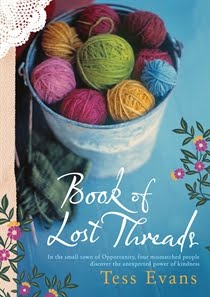
The Book of Lost Threads by Tess Evans
Courtesy of: Becky from Page Turners
The Book of Lost Threads is a pleasant and enjoyable debut novel by Australian author Tess Evans.
The book is about four miss-matched friends; Finn, Moss, Mrs Pargetterand Sandy. Moss is 20-something woman born to a lesbian couple who is struggling to come to terms with her identity. Finn is the 'anonymous' sperm donor who fathered her. He lives in a small country town called Opportunity, next door to Mrs Pargetterwho is still struggling to cope with the still birth of her child 40 years previously and who has been knitting tea cosies for the UN for several decades. Sandy is Mrs Pargetter's nephew and he has his own family's history to make peace with.
Together they help each other comes to terms with whatever it is that they have each been struggling to come to terms with.; love, guilty, loss.
The characters and their stories were really endearing, especially the story involving Mrs Pargetter and her tea cosies. It that sense, it was a sweet read, if not a literary masterpiece. The book did attempt to deal with big issues; love, death, family. I particularly admired Evan's having written about the child of a same-sex relationship. This is not a common theme amoungst many books that I have read, and I appreciated that Evans was willing to write about something different. It was refreshing to read about a family that wasn't your typical one, but at the same time you shouldn't read this book and expect any deep analysis of the issue.
Sometimes the characters did feel a bit caricature-ish and the story a little far fetched. I particularly didn't connect to Finn's story about the events that acted as his motivation for moving to Opportunity and living as a hermit. The time that he spends in the monastery and his subsequent return their in his apparent time of need (which I think was quite overdone) all seemed particularly artificial.
All in all though it was an endearing, easy read. I felt myself going along for the ride with the characters and I enjoyed myself.
Thursday, November 25, 2010
An Iron Rose by Peter Temple (Australian crime fiction)
Courtesy of: Becky from Page Turners
When I heard that Peter Temple was the first Australian crime writer to win the Miles Franklin Literary Award I jumped at the chance to read one of his novels.
I don't normally read crime fiction, but I really enjoyed this. It was a tightly constructed, tense read; a first person narrative from Mac Faraday's perspective. Mac Faraday who has retired from city life and is working as a blacksmith in a rural area. He is living the quiet life; spending time with friends, drinking at the pub and playing with an appalling football team. His world is turned upside down when his best friend Ned is found hanging one night and he becomes the carer for Ned's grandson. Instincts from his old life kick in when he comes across press clippings of a young girl's gruesome murder in 1980's, near a facility for wayward young girls. When he begins to investigate this further he becomes mixed up in a dangerous and confusing web of criminal activity. As people from his past start coming back to haunt him he finds that his life is in grave danger.
The style of Temple's writing is hard boiled, a style epitomised by authors such as Dashiell Hammet and Raymond Chandler. The writing is short, sharp and gritty.
The great thing about An Iron Rose is that this books adds a very Australian flavour to this style of writing. Temple provides us with an insight into the Australian language and lifestyle that is very authentic (which is not surprising from an Australian author, albeit one originally from South Africa).
Temple successfully paints the picture of a country town where a lot of the inhabitants know each other well and take their civic responsibility seriously. People share beers at the pub and have a laugh together at the footy. Some people might accuse Temple of stereotyping the Australian lifestyle, but I do think that this is very typical for a lot of people. I especially liked the way that Temple dealt with Ned's Aboriginality. It was mentioned in passing and then not mentioned again. Ned's background wasn't important in that sense, he was accepted as part of his community not because of his Aboriginality and not despite of it. It just wasn't a big deal. Acknowledging his Aboriginality without making anything of it within the story gave the book a more contemporary feel.
An Iron Rose is a wonderful mix of crime, noir and literary fiction and I can absolutely see how a book by Temple has won Australia's premier literary award. It is a very dark book; there is a sense of evil lurking under the surface that sends shivers up your spine.
When I heard that Peter Temple was the first Australian crime writer to win the Miles Franklin Literary Award I jumped at the chance to read one of his novels.
I don't normally read crime fiction, but I really enjoyed this. It was a tightly constructed, tense read; a first person narrative from Mac Faraday's perspective. Mac Faraday who has retired from city life and is working as a blacksmith in a rural area. He is living the quiet life; spending time with friends, drinking at the pub and playing with an appalling football team. His world is turned upside down when his best friend Ned is found hanging one night and he becomes the carer for Ned's grandson. Instincts from his old life kick in when he comes across press clippings of a young girl's gruesome murder in 1980's, near a facility for wayward young girls. When he begins to investigate this further he becomes mixed up in a dangerous and confusing web of criminal activity. As people from his past start coming back to haunt him he finds that his life is in grave danger.
The style of Temple's writing is hard boiled, a style epitomised by authors such as Dashiell Hammet and Raymond Chandler. The writing is short, sharp and gritty.
The great thing about An Iron Rose is that this books adds a very Australian flavour to this style of writing. Temple provides us with an insight into the Australian language and lifestyle that is very authentic (which is not surprising from an Australian author, albeit one originally from South Africa).
Temple successfully paints the picture of a country town where a lot of the inhabitants know each other well and take their civic responsibility seriously. People share beers at the pub and have a laugh together at the footy. Some people might accuse Temple of stereotyping the Australian lifestyle, but I do think that this is very typical for a lot of people. I especially liked the way that Temple dealt with Ned's Aboriginality. It was mentioned in passing and then not mentioned again. Ned's background wasn't important in that sense, he was accepted as part of his community not because of his Aboriginality and not despite of it. It just wasn't a big deal. Acknowledging his Aboriginality without making anything of it within the story gave the book a more contemporary feel.
An Iron Rose is a wonderful mix of crime, noir and literary fiction and I can absolutely see how a book by Temple has won Australia's premier literary award. It is a very dark book; there is a sense of evil lurking under the surface that sends shivers up your spine.
Friday, June 4, 2010
Lilian's Story by Kate Grenville

Courtesy of: Becky from Page Turners
Lilian's Story is based a true Sydney character named Bea Miles, a homeless woman famous particularly in the 1950's and 1960's for causing havoc and giving Shakespeare recitations around Central Station in Sydney. You can read more about her at the Australian Dictionary of Biography (Online Edition).
Having read The Secret River by Kate Grenville earlier this year (read my review here) and being a little disappointed I was a little apprehensive when I commenced Lilian's Story. Fortunately, I soon discovered that Lilian's Story is very different to The Secret River, in a good way.
Like The Secret River, Lilian's Story is written as a linear passage through time, however I think the depth of character Grenville establishes in Lilian's Story is far superior. It is written in first person narrative, which helps the reader gain an insight into Lilian's mind and thought processes.
The book has no plot per se, but rather it is an examination of Lilian's life experiences, from her birth through to her depth. Lilian was born in the year of Federation, raised by parents with traditional values and suffered from abuse perpetrated against her by her father. Her life follows no path, just as Lilian wouldn't have liked it to. Instead, she moved to the beat of her own drum, experiencing university, spending time in a mental institution and eventually living a happy and satisfying life as a homeless person in Sydney. It is really a very detailed examination of one person's daily realities, giving the reader a fascinating perspective not just on Lilian's personal history, but on Australia's post-Victorian history as well.
I have to admit to feeling somewhat uncomfortable reading about the early parts of her life, particularly her primary school years. I recognised my own awkwardness in her behaviour, and felt that I could identify with how she reacted to the bullying that she suffered from. She didn't shrink from the attention, instead she sought the other children's approval more and more desperately, by stealing things and making up stories. I really felt for Lilian reading about her formative years, I felt what she felt when she didn't receive the approval that she was so desperately seeking.
It was then interesting to see this unusual child turn into the young woman that she does. It was painful for me to see her grow into adulthood; struggling through university, negotiating male/female romantic relationships and surviving the horrific crime perpetrated against her by her own father.
Although her behaviour as a young woman is unusual to everyone for it's seeming rejection of typical norms and values, it still becomes more obvious that her unusual behaviour might be the result of an underlying problem. I know the publisher's description describes her as a "true eccentric", I suspect that more realistically she is suffering from a mental illness. Despite spending some time in a mental institution, she receives no diagnosis and no treatment, which I think is a comment on the historical attitude toward mental illness that existed at the time.
It was intriguing to see her navigate and survive her own adversity as an adult. Despite the set backs; the homelessness, the inadequacy of the legal system in dealing with a person like Lilian, she is happy with her life. She is content. She has what she believes is important. A home (albeit not one that you and I might consider a home), her one true love (although chaste) and an exciting city at her fingertips.
For me one of the most poignant moment was the moment when she celebrated her birthday on her own, wandering the streets of Sydney in the party dress that she had purchased for the occasion. It was perhaps one of the most sad moments for me. She seemed so happy, and yet there was this sense that underneath she was suffering.
Although I don't want to go into this sort of discussion to deeply, the themes of independence and sexuality were prominent in this story.
What struck me the most, however, was the idea of history in Lilian's Story. In a way, Lilian's life becomes a metaphor for the changes that Australia is experiencing. Lilian's personal history reflects Australia's history. Her rejection of social norms and customs could be thought to reflect the increasing separation Australia feels from England. Lilian's own very unique ideas of her own sexuality and her position as a woman in society could also be seen to reflect the growth of feminism in Australian society, particularly throughout the 60's. In this way I think that her year of being birth being the year of federation is integral to the story.
In the end, despite her unusual life, behaviour and idea's, Lilian is able to reflect positively on her life, and that is something that is inspiring.
Book Details: Paperback, 280 pages, published by Allen and Unwin, published in 1996
The Book Thief by Markus Zusak
Courtesy of: Becky from Page Turners
This absolutely unique piece of historical fiction moved me more than any book has done for a very long time, perhaps even since I read The Time Travellers Wife. This is a book for book lovers. The Book Thief is written by an Australian author, and it is is debut adult novel, after a career of writing children's fiction.
The protagonist of the novel is Liesel Meminger, a young girl growing up in Nazi Germany. It begins with the death of her brother, and her mother then leaving her in the care of the Huberman's, who become her new family. There is Mama, a fierce disciplinarian, and Papa a caring and warm man who dedicates hours to teaching Liesel to read. With the help of her Papa, she begins to read The Gravediggers Handbook, a book she finds following the burial of her brother.
What is particularly unique about this story of Nazi Germany, is that it is narrated by Death. Death doesn't introduce himself in those terms, but it becomes clear who is telling us the story of The Book Thief.
The style is expressive in a lyrical way, and is still very modern. Not only do we see the story unfold from Liesel's perspective, but we also have asides from Death, sometimes written as if they were on a gravestone. In effect, it is Death re-telling the story of Liesel, The Book Thief, and so we are provided many glimpses of the future of the story. This in no way deters the reader from reading on, it is one of those books where it is the journey to the conclusion that is the real joy of the book. Death himself acknowledges:
As we give in to the sensory reality of Death's narrative, we see Liesel experience the normal angst of childhood; struggling through school, going on adventures with her best friend Rudy Steiner and helping her Mama raise funds by collecting laundry from neighbours. It is in this last role that she is truly able to give in to her love of books, and she eventually begins stealing them from the mayors house, after she makes friends with the mayor's wife. It is this act, and the further acts of book thievery that lead Death to give her the name of 'The Book Thief''.
There is a darker side to her life though. She lives in a town a short distance from Dachau, and witnesses Jews being marched through her city. We witness her and Rudy's involvement in the Hitler Youth Movement, and cringe at the insidious way in which Nazism infects their daily lives. Nazism has a more significant impact upon her life when her family begins to shelter a Jew, Max Vandenberg.
This book is undoubtedly about the experience of human misery in WWII, and Zusak does a brilliant job of describing the realities and intricacies of the lives of German people during Hitler's reign. We see acts of cruelty and acts of kindness and love.
And yet, The Book Thief is also about the power of language. It is books that allow Liesel to recover after her brothers death and her mothers abandonment. Books and language bring her closer to her Papa and become integral to her relationship with Max Vandenberg and to a lesser degree the Mayor's wife. It is though books and storytelling that she brings comfort to those that she shares the bomb shelters with, and it is books that play an important role in those transgressions against the Nazi state that she and others are willing to commit. Significantly, it is because of books that Death is able to tell us Liesel's story at all.
This is a book that had tears rolling down my face on three different occasions. It is a powerful but sad story about human suffering and the importance of language in the modern world. If you are a book lover, and a lover of language, then I not only recommend this book to you, I ask you to read it.
This absolutely unique piece of historical fiction moved me more than any book has done for a very long time, perhaps even since I read The Time Travellers Wife. This is a book for book lovers. The Book Thief is written by an Australian author, and it is is debut adult novel, after a career of writing children's fiction.
The protagonist of the novel is Liesel Meminger, a young girl growing up in Nazi Germany. It begins with the death of her brother, and her mother then leaving her in the care of the Huberman's, who become her new family. There is Mama, a fierce disciplinarian, and Papa a caring and warm man who dedicates hours to teaching Liesel to read. With the help of her Papa, she begins to read The Gravediggers Handbook, a book she finds following the burial of her brother.
What is particularly unique about this story of Nazi Germany, is that it is narrated by Death. Death doesn't introduce himself in those terms, but it becomes clear who is telling us the story of The Book Thief.
The style is expressive in a lyrical way, and is still very modern. Not only do we see the story unfold from Liesel's perspective, but we also have asides from Death, sometimes written as if they were on a gravestone. In effect, it is Death re-telling the story of Liesel, The Book Thief, and so we are provided many glimpses of the future of the story. This in no way deters the reader from reading on, it is one of those books where it is the journey to the conclusion that is the real joy of the book. Death himself acknowledges:
"Of course, I'm being rude. I'm spoiling the ending, not only of the entire book, but of this particular piece of it. I have given you two events in advance, because I don't have much interest in building mystery. Mystery bores me. It chores me. I know what happens and so do you. It's the machination that wheel us there that aggravate, perplex, interest and astound me".Zusak skilfully creates Liesel's experience through Death's storytelling with the use of imagery. This is because Death gives a very sensory account of the world, describing events, places and people with phrases such as"the smell of friendship", "scent of Hitler's gaze" and "For me, the sky was the colour of Jews". We are left with strong and clear images burned into our minds as we watch Liesel's story unfold.
As we give in to the sensory reality of Death's narrative, we see Liesel experience the normal angst of childhood; struggling through school, going on adventures with her best friend Rudy Steiner and helping her Mama raise funds by collecting laundry from neighbours. It is in this last role that she is truly able to give in to her love of books, and she eventually begins stealing them from the mayors house, after she makes friends with the mayor's wife. It is this act, and the further acts of book thievery that lead Death to give her the name of 'The Book Thief''.
There is a darker side to her life though. She lives in a town a short distance from Dachau, and witnesses Jews being marched through her city. We witness her and Rudy's involvement in the Hitler Youth Movement, and cringe at the insidious way in which Nazism infects their daily lives. Nazism has a more significant impact upon her life when her family begins to shelter a Jew, Max Vandenberg.
This book is undoubtedly about the experience of human misery in WWII, and Zusak does a brilliant job of describing the realities and intricacies of the lives of German people during Hitler's reign. We see acts of cruelty and acts of kindness and love.
And yet, The Book Thief is also about the power of language. It is books that allow Liesel to recover after her brothers death and her mothers abandonment. Books and language bring her closer to her Papa and become integral to her relationship with Max Vandenberg and to a lesser degree the Mayor's wife. It is though books and storytelling that she brings comfort to those that she shares the bomb shelters with, and it is books that play an important role in those transgressions against the Nazi state that she and others are willing to commit. Significantly, it is because of books that Death is able to tell us Liesel's story at all.
This is a book that had tears rolling down my face on three different occasions. It is a powerful but sad story about human suffering and the importance of language in the modern world. If you are a book lover, and a lover of language, then I not only recommend this book to you, I ask you to read it.
Book Details: Paperback, 584 pages, published by Pan MacMillan Australia, published in 2008, English
Subscribe to:
Posts (Atom)